
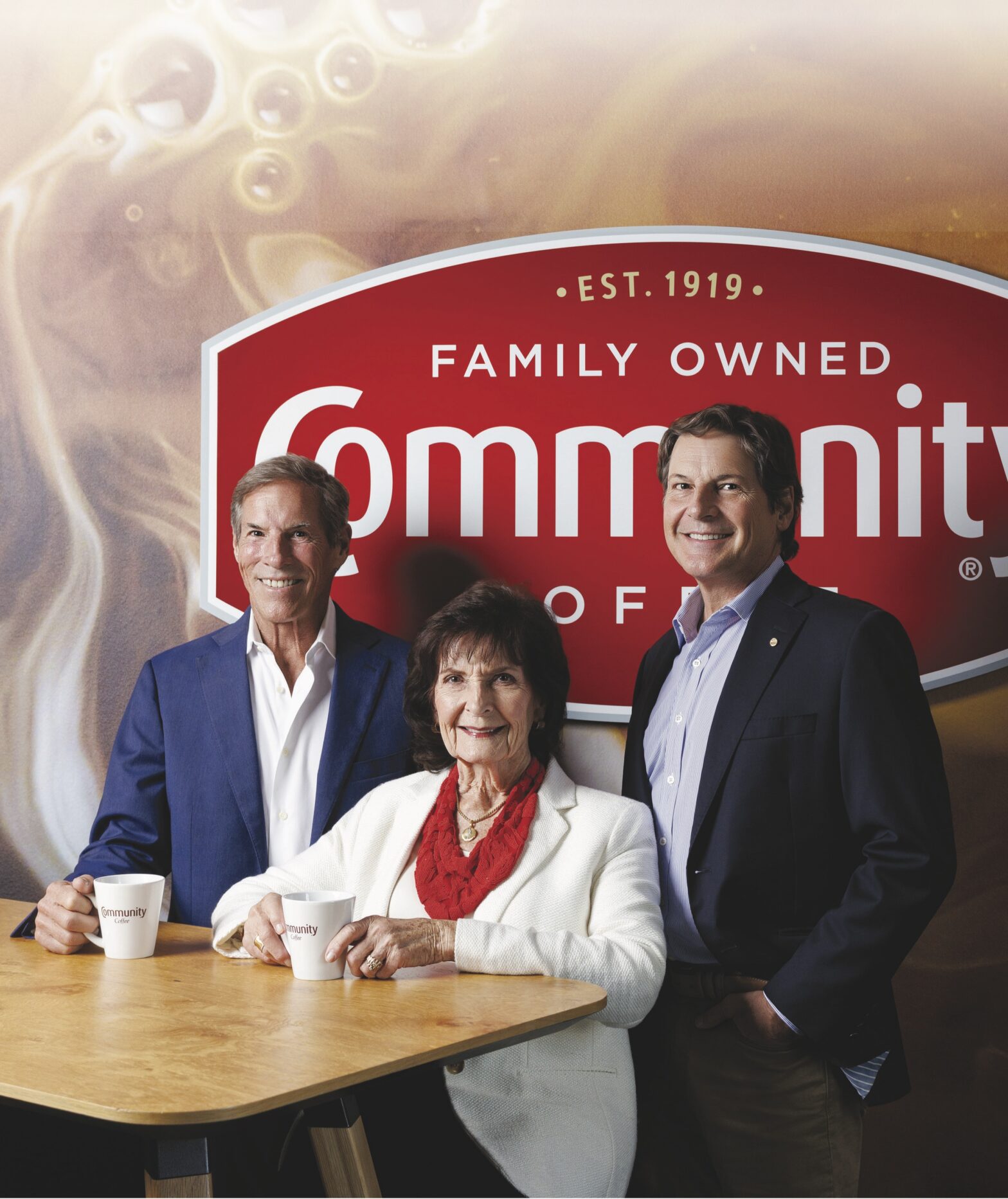
The Next Generation of Giving
By Sarah Bongiorni and Sarah Gardner | Photo by Collin Richie
Like its beloved coffee, the Saurage family aims to nurture a sense of community through their family philanthropy.
Its legacy of giving back dates to the 1919 founding of Community Coffee by Norman “Cap” Saurage. The Saurage family’s storied generosity started with a complimentary cup of coffee in Cap’s grocery store in Baton Rouge. More than 100 years later, that generosity has grown to include strategic philanthropy and grants in areas as varied as cancer research, public education, the arts and sustainable coffee farming.
“When the community’s good to us, we need to give back,” said Donna Saurage, lifelong philanthropist and family matriarch. “If you’re a Saurage, it’s what you do.”
The family has partnered with BRAF for decades on initiatives to make life better in Baton Rouge and bolster the capacity of the region’s nonprofit sector. The family takes philanthropy seriously and encourages members to embrace giving to causes that mean most to them.
Matt, Hank, Donna, and Cary Saurage recently teamed with BRAF on what might be their most personal collaboration to date: development of a consolidated family foundation to continue the legacy of giving and provide opportunity for the youngest members of the family to shape that legacy for generations to come.
To that end, the newly established Saurage Family Foundation will support grantmaking in areas of longstanding interest to individual family members as well as new areas that reflect the interests of children and grandchildren ranging in age from teens to thirty-somethings.
In other words, the new foundation is designed not just for teaching younger members of the Saurage family about philanthropy, but listening to their ideas about giving, too.
Matt Saurage is an active member of BRAF’s board and a founding member of World Coffee Research, which supports sustainable coffee farming methods in Brazil and elsewhere, where travel for business is a source of important connection.
Hank Saurage is an emeritus member of Baton Rouge Green’s board of directors in recognition of his role in fostering healthy, green spaces across the city. His two hands-on stints on the board included planting trees in parts of town in need of shade and beauty.
Their mother’s record of civic leadership is nothing short of staggering. Donna Saurage has served on the boards of 50 local nonprofits over the years, and she’s not done giving her time to what she believes in.
Cary Saurage, Donna’s brother-in-law, cared deeply about supporting the arts. Before passing away in 2025, he leveraged his fund at the Baton Rouge Area Foundation to support nearly 40 local arts organizations and museums.
Now, with the creation of the Saurage Family Foundation, Cary’s legacy will continue, shepherded by Donna, Hank, Matt, and trusted advisors.
As a supporting organization, the consolidated family foundation will operate in perpetuity to support both the interests of the founders, and those of the future generations of philanthropists in the Saurage family.
“We have this mechanism now to get our kids involved,” said Hank Saurage. “This is about what we can do together as a family.”
BRAF suggested a supporting organization structure to ensure straightforward grantmaking and facilitate communication about giving within the large and busy family —objectives identified by Matt, Hank, Donna, and Cary Saurage.
For that reason, the family foundation does not spell out percentages of giving in specific areas, instead allowing grantmaking that responds to evolving community needs and individual interests.
“Nobody’s hands are tied,” said Donna Saurage. “For me, what’s exciting is the grandchildren are being brought into the process.”
Grantmaking in new areas will be shaped by the passions of the youngest members of the family and community needs identified by the family foundation’s seven-member board.
“We’re providing a vehicle for them to express their desires [about giving] where they have deep interests,” said Matt Saurage.
In recognition of the mobile nature of many young people, the family foundation permits grantmaking in other communities should the children or grandchildren move out of the region or state.
“We don’t know where the children or grandchildren will be in 50 years, but wherever they are they will be able to give in their communities,” said Donna Saurage.
The family foundation will facilitate communication about giving among family members to prevent duplication or gaps in giving and provide a structure for educating younger family members about why giving matters.
Better communication within the family will benefit nonprofits by providing clarity about what support they can expect over a longer time, noted Matt Saurage.
“This gives us a vehicle for consistent, thoughtful and sustainable support to nonprofits to help them achieve real results,” he said.
Passing on knowledge about philanthropy and the family business has been a focus of interest for the Saurages for years.
A family lunch years ago highlighted the need for more frequent communication about giving when the Saurage brothers and their mother brought printouts of their individual giving from the year before. They discovered both duplicates and gaps in giving.
“It showed the importance of meeting and talking about things that are important in order to bring transparency to what the family is doing and why,” said Matt Saurage.
“We were very close, but we didn’t know what each branch of the family was doing financially,” added Hank Saurage, “so we decided to share and ask each other what we were doing.”
Shortly thereafter, the three began weekly calls on Tuesdays to support better communication about the business, charitable giving and how to best prepare the younger generation for those responsibilities, Matt Saurage said.
“The Saurage Family Foundation sort of brings all of this together,” he said.
Starting this fall, the family foundation will begin holding whole family meetings at least twice a year. The oldest grandchildren and their spouses will join the weekly Zoom calls in coming months.
Among potential matters for discussion: how the family can support Baton Rouge through large projects or initiatives with big impact — something the consolidated foundation makes possible.
“This allows us to think about new areas to support,” Matt Saurage said.
The family foundation’s supporting organization design offers advantages beyond perpetuity for some donors.
Supporting organizations are not required to pay out 5 percent of funds each year, as private foundations must do. And, private foundations often rely on costly overhead structures or family-led administrative support to keep them running compliantly. By contrast, the Saurage Family Foundation will function almost like a turnkey operation, with BRAF providing governance, grantmaking support and other back-office infrastructure on an à la carte basis.
Partnering with the Baton Rouge Area Foundation will enable the Saurage Family Foundation to leverage BRAF’s more than 60 years of experience in facilitating philanthropic activity.
The family foundation will have its own name on letterhead and checks sent to grantees by BRAF to help keep its legacy and identity clear.
It also has its own board of directors to oversee grant recommendations, explained Lauren Crapanzano Jumonville, senior vice president of enterprise strategy at BRAF.
“It’s a wonderful philanthropic structure,” added Crapanzano Jumonville, a member of the Saurage Family Foundation’s seven-member board, which includes four external members appointed by BRAF.
The board will help identify needs and opportunities for giving that align with the family’s values and legacy, said Scott Hensgens, another BRAF-appointed member of the board.
“We help them focus on areas that interest them and where they can make an impact,” Hensgens said.
For Donna Saurage, the new foundation provides a means to pass on giving that’s been important to the family for generations and to ensure it has optimal impact, she noted.
Working with BRAF made that possible, she said.
“BRAF is the steady nonprofit that will be here in perpetuity and has the best knowledge of what the needs of the community are,” she said. “We have faith in BRAF and its understanding of community needs and have depended on them for many years.”